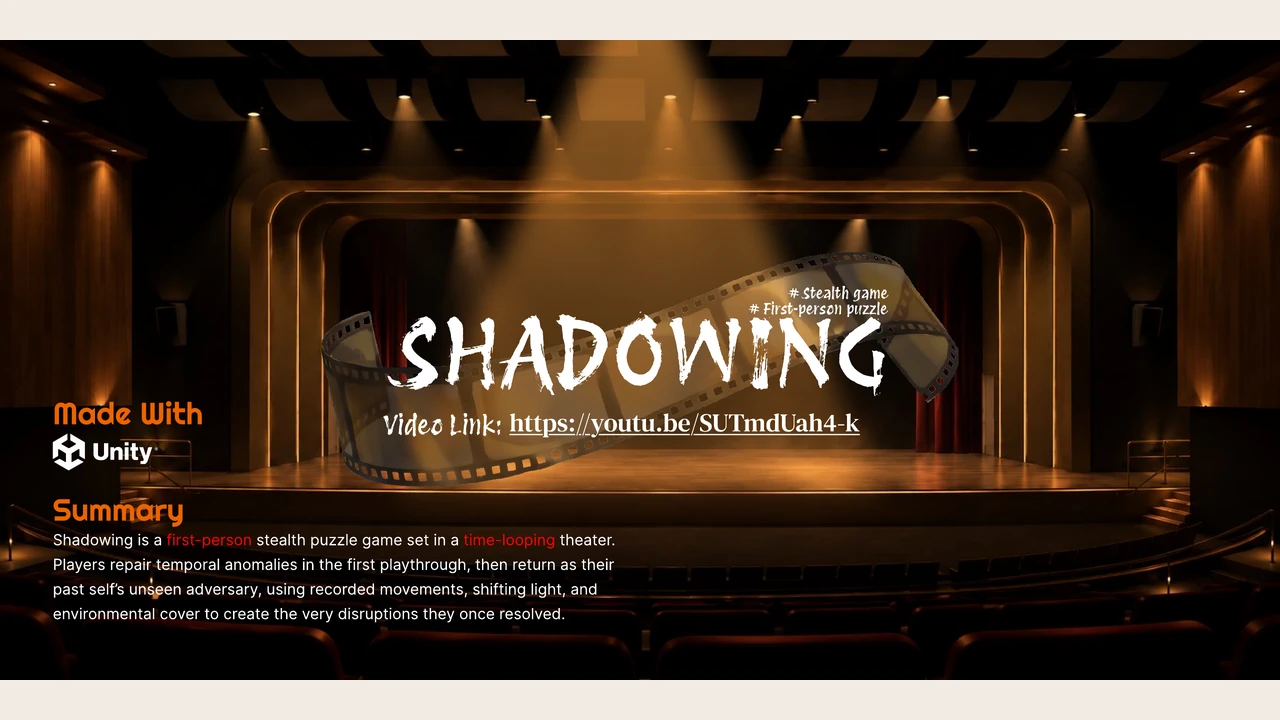
Game Project · First-Person Stealth Puzzle
Shadowing
Repair the anomalies. Return to become their cause. A time-looping theater turns your recorded movement and gaze into the threat you must avoid.
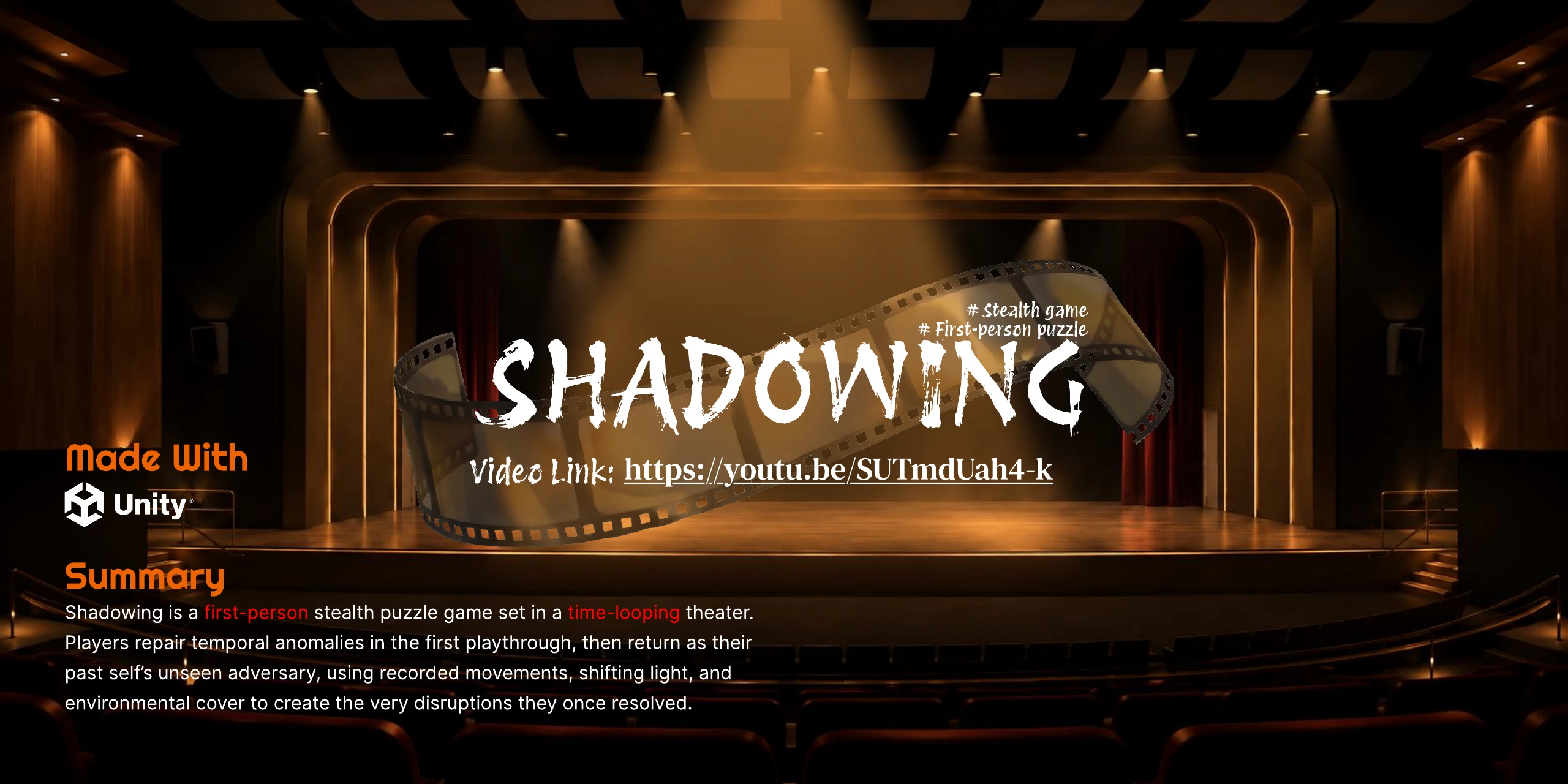
- Role
- Game design & programming
- Format
- First-person stealth puzzle · Two-playthrough time loop
- Tools
- Unity · C# · Timeline
- Status
- Unfinished prototype · Third iteration (A3)
- Watch
- Gameplay video ↗
Overview
A theater repeats three acts: Arrival, Independence, and Departure. In the first playthrough, the player arrives as a time repairer, restoring performances disrupted by temporal anomalies while the game records their route and gaze.
The second playthrough reverses that role. Returning from the future to prevent an impending fire, the player must create the very disruptions they once repaired without being seen by their past self. The anomalies become a distress signal across time, connecting the two playthroughs in a causal loop.
My Role
I developed the gameplay structure around a connection between temporal effects, spatial interaction, and recorded player behavior. The replay becomes both a stealth obstacle and a way of telling the story.
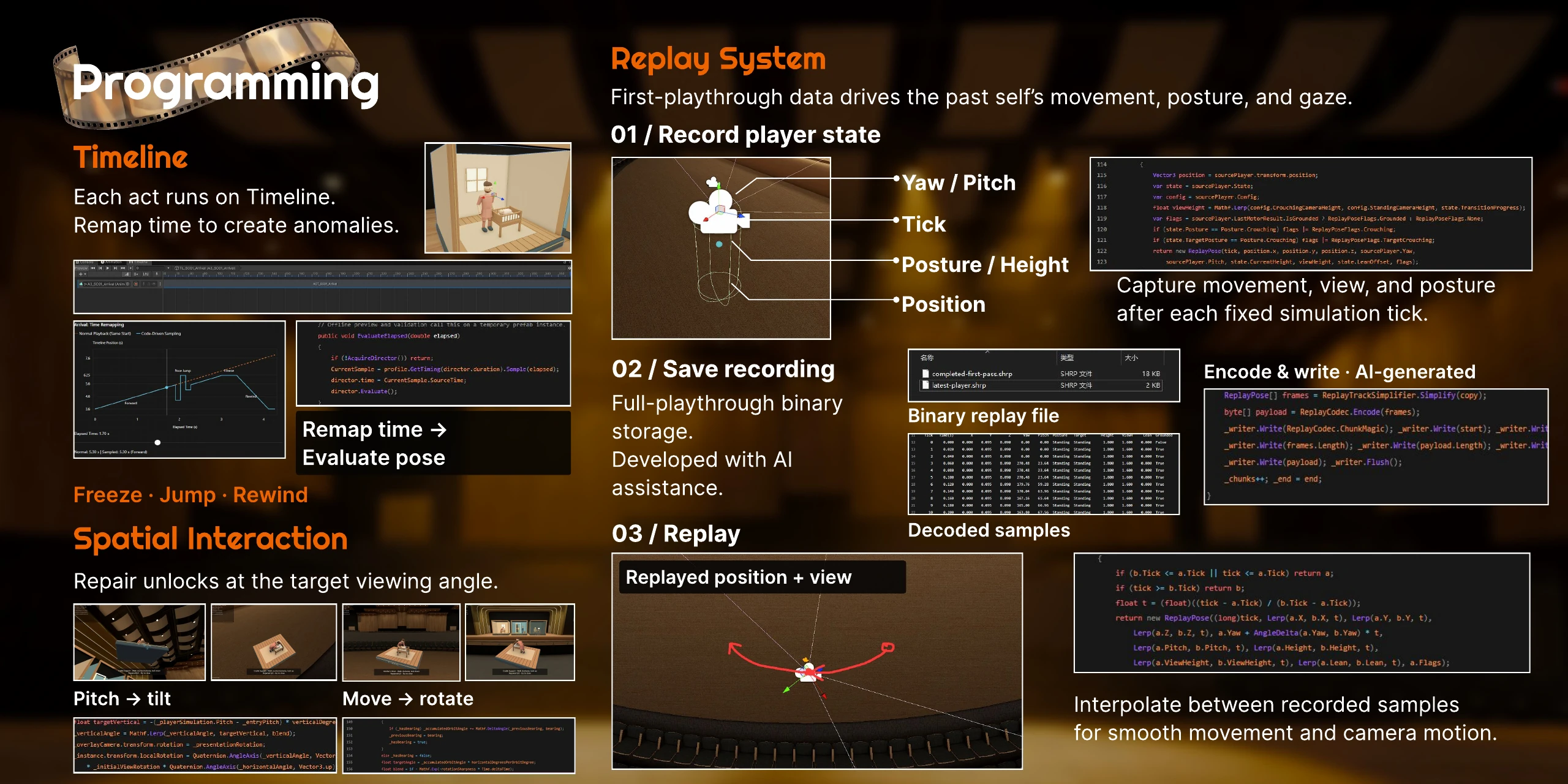
- Timeline-based performance: remap time to create freezes, rewinds, and frame jumps in each act.
- Spatial repair interactions: movement rotates the view and looking up or down changes its tilt; repair becomes available at the target angle.
- Player recording: capture position, yaw, pitch, posture, and height after fixed simulation ticks.
- Replay: store a full-playthrough binary recording and interpolate between samples to reproduce movement and gaze. Binary storage was developed with AI assistance.
Project Deck
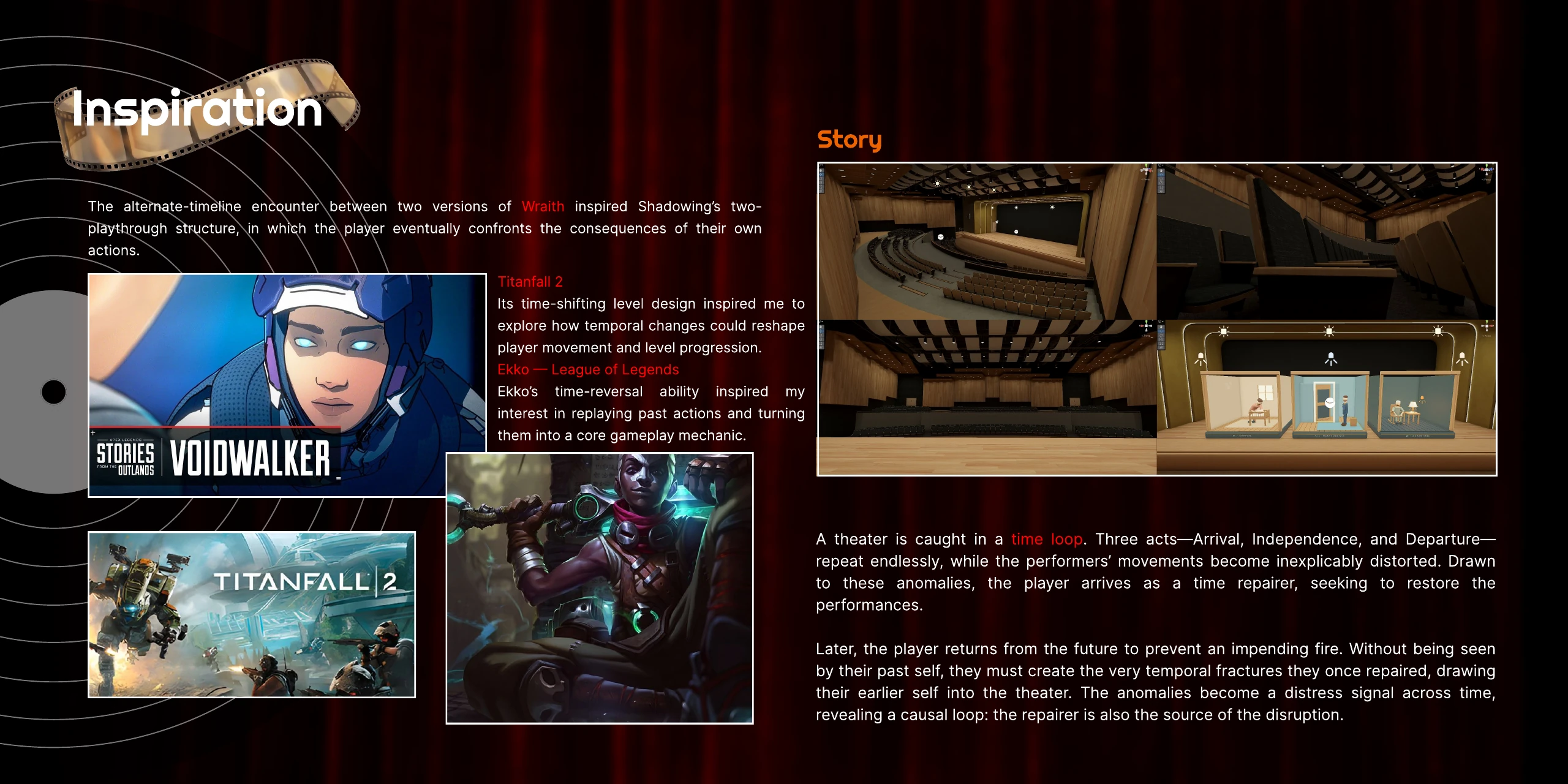
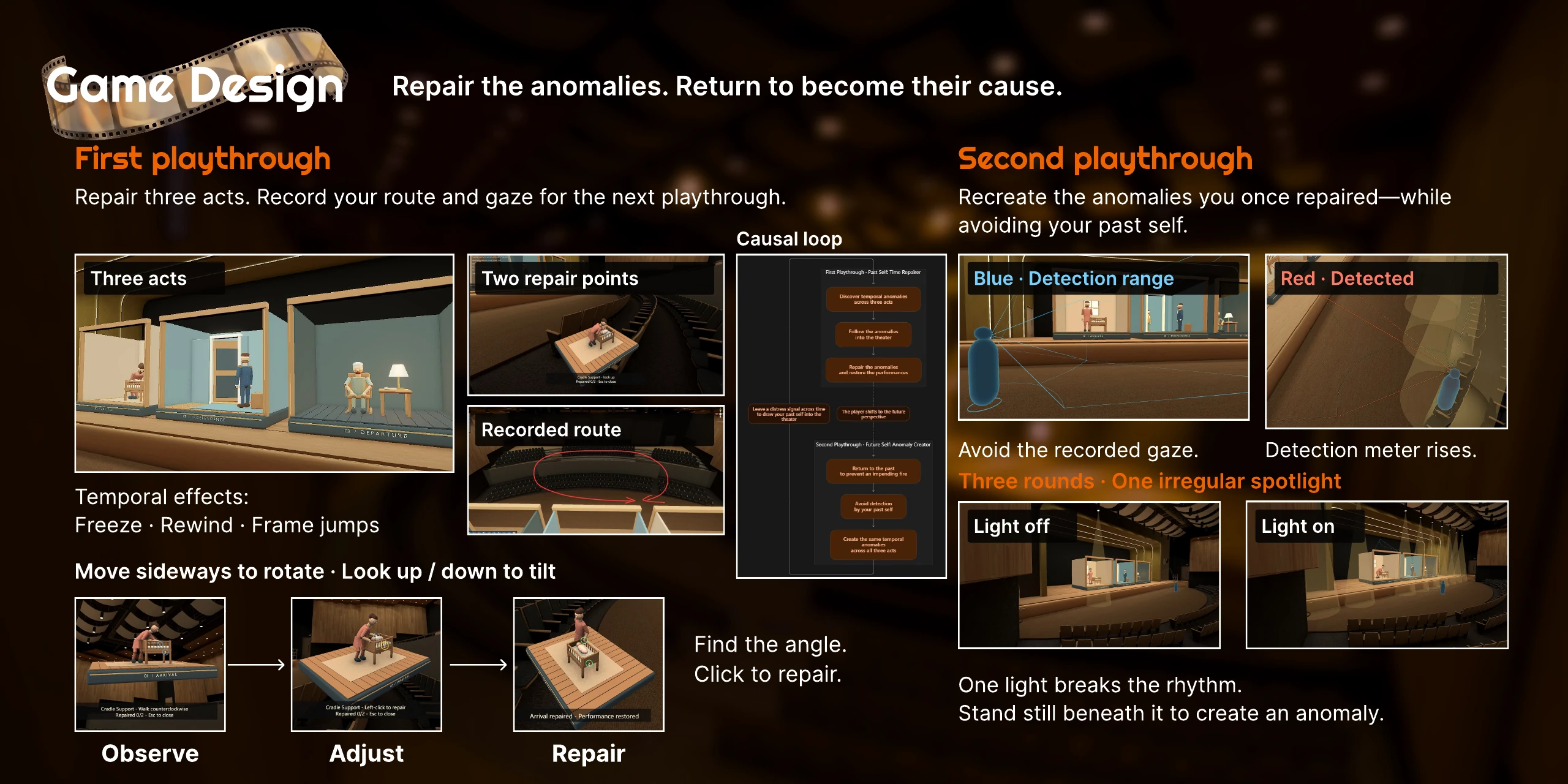
Click any slide to open it at full resolution.
Reflection & Next Steps
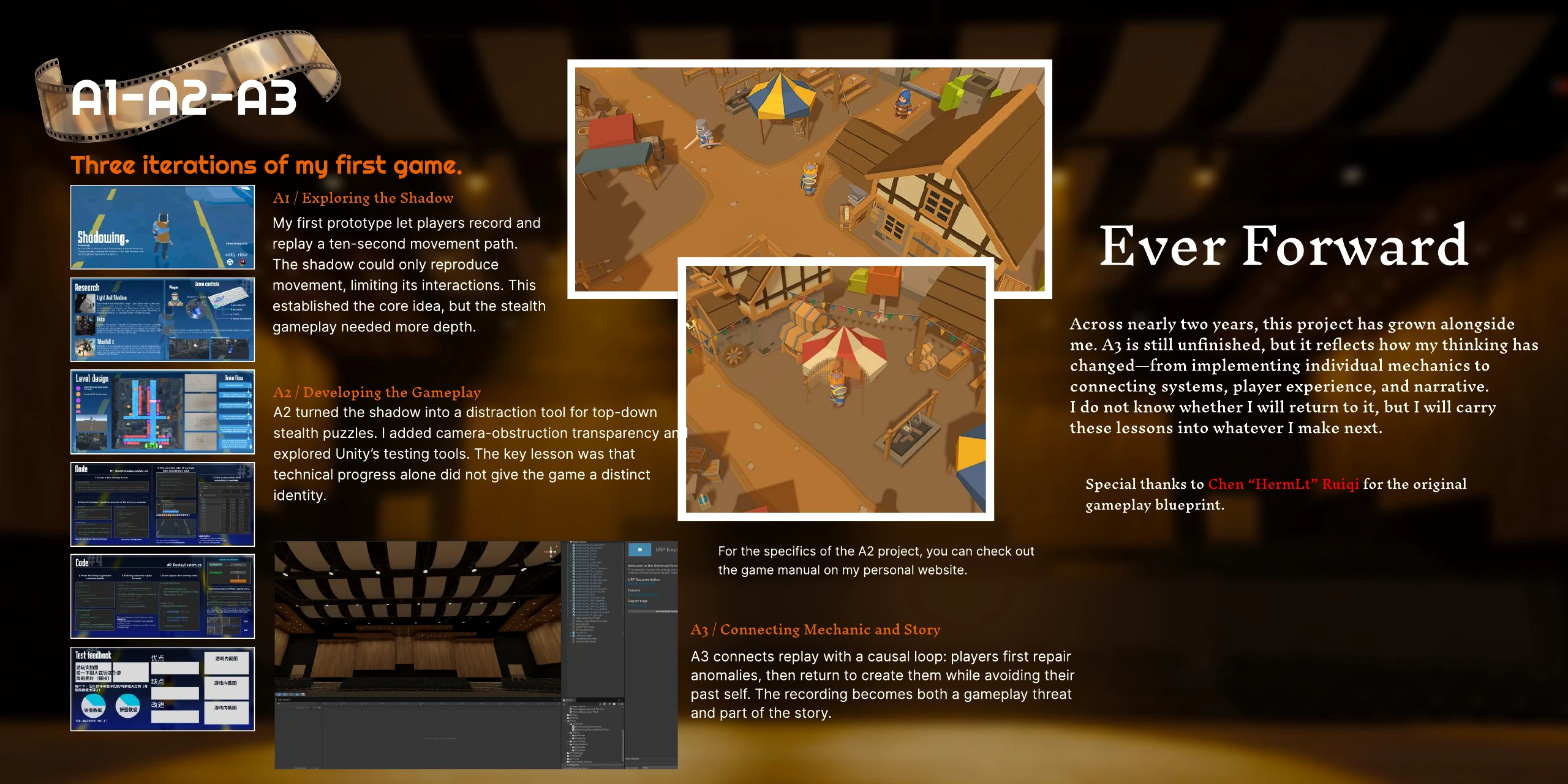
The project grew through three iterations. A1 explored recording and replaying a ten-second movement path. A2 turned that recording into a distraction tool for top-down stealth puzzles. A3 connects the mechanic to a story in which the player becomes the cause of the events they previously resolved.
A3 remains unfinished. Its most valuable lesson was learning to connect individual systems to the player experience and narrative, rather than treating technical progress as a complete game identity. Special thanks to Chen “HermLt” Ruiqi for the original gameplay blueprint.